
Experts Reveal the Top 3D Furniture Design Service Trends That Will Dominate 2026

The furniture design and manufacturing industry is undergoing a quiet but powerful transformation. As customer expectations rise and product cycles shorten, businesses are under increasing pressure to deliver accurate, visually compelling, and production-ready furniture designs faster than ever before. Traditional 2D workflows are no longer enough to keep up.
This is why 3D Furniture Design Service adoption is accelerating across the UK and globally. From startups and boutique interior studios to large furniture manufacturers and architects, businesses are embracing advanced 3D workflows to reduce errors, improve approvals, and stay competitive.
So, what does the future hold?
Industry experts agree that 2026 will be a defining year for how furniture is designed, visualised, approved, and manufactured. In this article, we explore the top 3D furniture design trends set to dominate 2026, and why forward-thinking businesses are already preparing for this shift.
Why Is 3D Furniture Design Becoming a Strategic Advantage?
Before diving into trends, it’s important to understand why 3D furniture design has become essential.
According to industry data published by McKinsey, design-related errors and late-stage changes remain one of the biggest cost drivers in manufacturing and construction. Furniture projects especially custom interiors are particularly vulnerable to fitment issues and rework.
A modern 3D Furniture Design Service helps businesses:
- Visualise complex components before production
- Detect errors earlier in the design phase
- Speed up stakeholder approvals
- Improve coordination between designers, engineers, and manufacturers
With that foundation in mind, let’s look ahead to the trends shaping 2026.
1. Why Will Hyper-Detailed 3D Furniture Design Drawings Become the New Standard?
By 2026, basic 3D models will no longer be enough. Experts predict a major shift toward highly detailed, manufacturing-ready 3D Furniture Design Drawings.
These drawings go beyond aesthetics and include:
- Exact dimensions and tolerances
- Material specifications
- Joinery and fixing details
- CNC and fabrication-ready data
This trend is driven by tighter margins and rising material costs. According to Statista, global furniture manufacturers are increasingly investing in digital tools to reduce waste and improve production efficiency.
What this means for businesses:
Firms that rely on vague or simplified models will struggle, while those using precise 3D drawings will reduce rework and shorten production cycles.
2. How Is Photorealistic 3D Furniture Changing Client Expectations?
One of the most visible trends dominating 2026 is the growing demand for Photorealistic 3D Furniture visualisation.
Clients, whether homeowners, developers, or retail brands now expect to see exactly what they’re getting before manufacturing begins.
Photorealistic visuals offer:
- Realistic materials, textures, and finishes
- Accurate lighting and spatial context
- Better emotional connection for buyers
Research from Autodesk highlights that visual clarity significantly improves client confidence and reduces late-stage design changes.
Voice-search-friendly insight:
“Why do clients prefer photorealistic 3D furniture designs?”
Because they remove ambiguity and allow faster, more confident decision-making.
3. Why Are Furniture Brands Demanding Faster Turnaround from 3D Furniture Design Services?
Speed is becoming a competitive weapon.
With shorter project timelines and faster go-to-market expectations, businesses are turning to specialised 3D Furniture Design Services to accelerate workflows without compromising accuracy.
Key drivers include:
- Rapid prototyping without physical models
- Faster internal and client approvals
- Parallel design and engineering workflows
According to Deloitte, companies that digitise design stages are significantly more agile and responsive to market changes.
By 2026, slow design cycles will be a liability, not just an inconvenience.
4. How Will Integration with Manufacturing Technology Shape 3D Furniture Design?
Another trend experts highlight is deeper integration between 3D design and manufacturing systems.
Modern furniture projects increasingly rely on:
- CNC machining
- Automated cutting and drilling
- Modular manufacturing systems
As a result, a 3D Furniture Design Company must now think beyond visuals and ensure models are production-ready.
This means:
- Exportable CAD formats
- Compatibility with fabrication software
- Accurate assembly logic
Businesses that fail to align design with manufacturing technology risk delays and costly revisions.
5. Why Are More Companies Partnering with Specialist 3D Furniture Design Companies?
By 2026, outsourcing to a professional 3D Furniture Design Company will become the norm not the exception.
Why?
Because maintaining in-house teams for every design requirement is expensive and inefficient. Specialist partners offer:
- Access to skilled CAD professionals
- Scalable resources based on project demand
- Consistent quality across multiple projects
This shift mirrors broader industry trends. Research from NBS shows increasing reliance on digital design specialists across architecture and construction in the UK.
6. How Is Sustainability Influencing 3D Furniture Design Trends?
Sustainability is no longer optional.
With stricter regulations and eco-conscious consumers, 3D furniture design is playing a critical role in reducing waste.
Advanced 3D workflows allow businesses to:
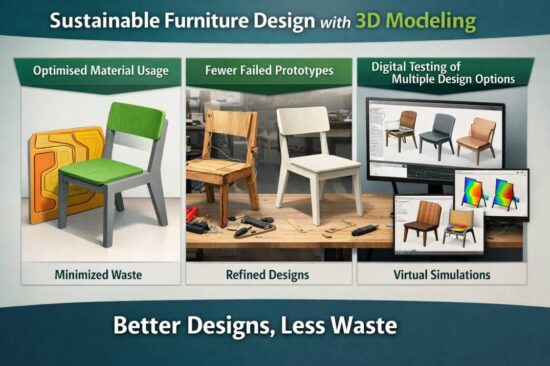
Alt Text: Sustainable furniture design using 3D modeling to reduce material waste
- Optimise material usage
- Reduce failed prototypes
- Test multiple design options digitally
This aligns with the UK’s broader push toward sustainable construction and manufacturing practices, as highlighted by UK Green Building Council.
7. What Challenges Should Businesses Prepare for Before 2026?
Despite the opportunities, experts caution that businesses must address several challenges:
- Choosing the right 3D Furniture Design Service partner
- Ensuring data security and IP protection
- Aligning 3D workflows with existing teams
Those who approach adoption strategically will benefit the most.
What Should Businesses Do Now to Stay Ahead?
To prepare for 2026, experts recommend:
- Auditing current design workflows
- Investing in advanced 3D Furniture Design Drawings
- Leveraging photorealistic visuals for approvals
- Working with experienced 3D design specialists
Early adopters will gain a competitive edge long before these trends become standard practice.
Final Thoughts
The future of furniture design is digital, precise, and visual.
As 3D Furniture Design Service trends continue to evolve, businesses that embrace these changes will reduce risk, improve quality, and respond faster to market demands. Those that don’t may find themselves struggling to keep up.
In the UK and globally, many forward-thinking firms are already partnering with experienced CAD and 3D furniture design specialists to future-proof their operations, quietly gaining an edge in an increasingly competitive industry.
FAQs:
1. What is a 3D furniture design service?
A 3D furniture design service creates detailed digital models of furniture that show dimensions, materials, components, and finishes, helping businesses visualise and validate designs before manufacturing.
2. Why are 3D furniture design services becoming more important in 2026?
Rising demand for accuracy, faster approvals, and reduced rework is driving adoption. Businesses are increasingly using 3D furniture design services to stay competitive and improve production efficiency.
3. How do 3D furniture design drawings improve manufacturing accuracy?
3D furniture design drawings provide precise measurements and construction details, reducing misinterpretation and helping manufacturers avoid costly errors during fabrication and installation.
4. What role does photorealistic 3D furniture play in client approvals?
Photorealistic 3D furniture visuals allow clients to see realistic finishes, textures, and proportions, making it easier to approve designs and reducing last-minute changes.
5. Are 3D furniture design services suitable for custom furniture projects?
Yes. Custom and bespoke furniture projects benefit greatly from 3D design services, as complex components and fitment details can be validated digitally before production begins.
6. How are UK furniture manufacturers using 3D furniture design services?
UK manufacturers use 3D furniture design services to meet strict quality standards, manage space constraints, comply with regulations, and coordinate better with architects and interior designers.
7. What industries benefit most from 3D furniture design services?
Industries such as interior design, hospitality, retail fit-outs, residential development, and commercial furniture manufacturing benefit most from accurate 3D furniture design workflows.
8. Will 3D furniture design services replace traditional shop drawings?
In many cases, yes. Advanced 3D furniture design drawings are increasingly replacing traditional shop drawings because they provide better clarity, fewer errors, and smoother collaboration.
9. How do businesses choose the right 3D furniture design company?
Businesses should look for a 3D furniture design company with industry experience, technical expertise, strong communication processes, and the ability to deliver manufacturing-ready drawings.
10. Is outsourcing 3D furniture design services cost-effective?
Outsourcing is often cost-effective because it reduces overhead, speeds up delivery, and gives businesses access to specialised design expertise without long-term staffing commitments.