Boiler vs. Furnace: Which Heating System Is Right for Your Michigan Home?
If your Grand Rapids home is due for a new heating system, you’ve probably run into the boiler vs. furnace question. The two systems work differently, cost differently, and suit different homes. Grapids Home Services, has been helping Michigan homeowners sort through this decision since 1999, backed by a BBB A+ rating and decades of hands-on local experience.
Boiler or Furnace: A Question Worth Asking Before Michigan Winter Hits
Grand Rapids winters are not mild. The heating season runs from October through April, with January lows averaging near 18 degrees Fahrenheit, one of the longer heating seasons in the Midwest. A significant share of homes in the area date to the early 20th century. In neighborhoods like Heritage Hill and Eastown, cast-iron radiator systems are common, and for many homeowners the boiler versus furnace decision arrives when an aging system finally gives out.
This is an infrastructure-level decision. The wrong choice can mean thousands of dollars in retrofit work or years of unnecessary energy costs.
How Each System Actually Heats Your Home
The core difference comes down to one question: does the system move warm air or warm water?
How a Furnace Works
A furnace burns natural gas or uses electricity to heat air, then a blower motor pushes that air through ductwork and out of registers in each room.
- High-efficiency condensing furnaces carry AFUE ratings between 80 and 98 percent
- A 96 AFUE rating means 96 cents of every dollar spent on gas becomes usable heat
- Most homes in Comstock Park and Walker built after the 1970s already have ductwork in place
- Forced-air systems can dry out indoor air during West Michigan winters; pairing with a whole-home humidifier is a common fix
- Michigan code requires sealed-combustion units in newer tight homes to be properly vented and condensate-drained
For newer subdivisions with existing ductwork, a furnace replacement is usually the most direct path. Schedule a furnace installation estimate and a technician will measure the home’s heat load before recommending a size.
How a Boiler Works
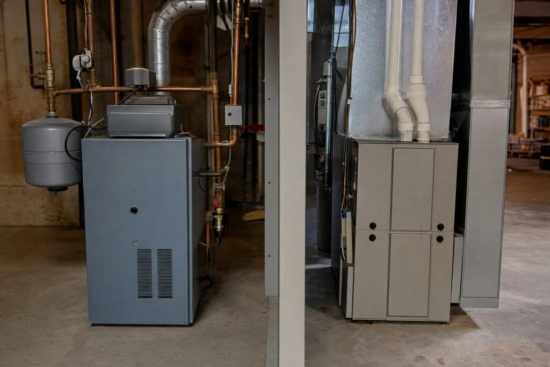
A boiler heats water and circulates it through pipes to cast-iron radiators, baseboard convectors, or radiant floor tubing. Heat radiates into the room rather than blowing through vents — what heating professionals call hydronic heat.
- Boilers run on natural gas, propane, or oil
- Heat output is steadier and more even than forced air
- No ductwork needed, which matters in older homes without it
- Many century-old homes near Cherry Hill and the Westside still rely on original cast-iron radiator systems
For homes built before 1960, the existing system usually points the way. Replacing a boiler with another boiler is often simpler than converting to forced air. Ask about Grapids Home Services’ boiler installation if your radiators are losing their warmth.
Boiler vs. Furnace at a Glance
| Factor | Furnace | Boiler |
| Upfront cost range | Lower, especially with existing ductwork | Higher, particularly for cast-iron or radiant systems |
| Typical lifespan | 15 to 20 years | 20 to 30 years |
| Efficiency (AFUE) | 80 to 98 percent | 82 to 96 percent |
| Best home type | Post-1970 homes with ductwork | Pre-1960 homes with radiators |
| Maintenance frequency | Annual, plus regular filter changes | Annual, plus pressure and water-level checks |
Frequently Asked Questions
Is a boiler or furnace better for a Michigan winter?
Both systems handle a Michigan winter effectively when properly sized. The real deciding factor is existing infrastructure — ductwork points toward a furnace, radiators toward a boiler. Grand Rapids logs roughly 6,800 heating degree days a year, well above the national average, so proper sizing and annual maintenance matter more than system type.
How long do furnaces and boilers last in Michigan?
Furnaces typically last 15 to 20 years with regular maintenance. Boilers run longer — often 20 to 30 years — because they have fewer moving parts. Annual tune-ups are the single biggest factor in reaching either lifespan, especially in a climate where systems run hard for six-plus months.
Can I switch from a boiler to a furnace in my older Grand Rapids home?
Converting is possible but rarely practical for pre-1960 homes in neighborhoods like Heritage Hill or Eastown. Removing cast-iron radiators and routing ductwork through finished walls and ceilings is a major renovation. In most cases, replacing the boiler with a modern condensing unit is faster and significantly less expensive. The answer is usually to get a quote for a boiler replacement rather than a full system change.
Which heating system is cheaper to run in Michigan?
Operating costs depend on fuel prices, insulation, and system efficiency. Many Grand Rapids homeowners see winter gas bills in the $90 to $180 per month range during the coldest stretch. Upgrading from an aging 80 AFUE furnace to a 96 AFUE condensing model can trim roughly 15 to 20 percent off annual heating costs — often a few hundred dollars a year in a typical 1,500-square-foot home. Boilers hold a practical advantage in homes with leaky ductwork, since hydronic systems have no duct heat loss. For an accurate operating-cost figure, a load calculation on the specific home is the most reliable approach.
Do boilers or furnaces need more repairs?
Furnaces have more mechanical components — blower motors, filters, igniters, limit switches — and tend to need more frequent minor service calls. Boilers are mechanically simpler but require regular monitoring of water pressure, expansion tanks, and valves. Annual professional maintenance benefits both systems.
About Grapids Home Services
Grapids Home Services is an HVAC, plumbing, and electrical company based at 3325 3 Mile Road NW, Grand Rapids, MI 49534, serving homeowners across the Grand Rapids area and surrounding communities, including Comstock Park, Belmont, and Cascade. Founded in 1999, the company holds a BBB A+ rating and is both BBB Accredited and HomeAdvisor Screened and Approved. Services cover heating, air conditioning, boiler and furnace work, heat pumps, geothermal systems, and ductless HVAC, with a focus on the specific demands of West Michigan’s climate.
Business Name: Grapids Home Services
Address: 3325 3 Mile Road Northwest, Grand Rapids, MI 49534
Phone number: (616) 210-3456