
How to Decorate a Small Home Step by Step (Without Making It Feel Like a Closet)
Small spaces have a reputation they don’t deserve. Most people assume a small home is a design problem waiting to be solved with more money or more square footage. But after spending years helping people rethink cramped apartments and tight layouts, I can tell you the real issue is almost never the size—it’s the sequence. People skip steps, buy the wrong things first, and then wonder why the room still feels off.
This guide walks you through how to decorate a small home step by step in the order that actually works.
What Does It Actually Mean to Decorate a Small Home Step by Step?
Decorating a small home step by step means planning layout and design choices in a strict sequential order: space assessment first, color second, furniture layout third, storage fourth, and warmth last. Skipping ahead causes the most common small-space mistakes: rugs that are too small, furniture pushed flat against walls, and rooms that feel cluttered even when they’re technically tidy. Learn how to decorate a small home step by step to create a comfortable, organized, and stylish living space.
Step 1: Assess the Space Before You Touch Anything
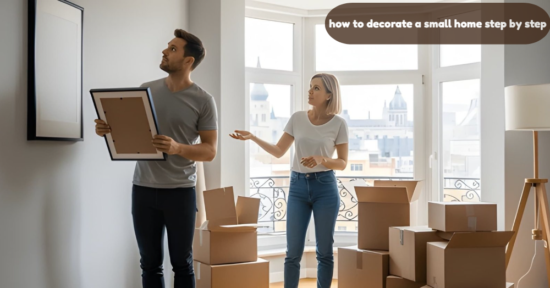
Sit in the room. Seriously—just sit there for a few minutes before moving a single thing. Notice where natural light enters. Track where your eye goes first. Feel where movement gets blocked.
This isn’t decorating advice; it’s spatial awareness. And most people skip it entirely because it feels passive. But Mark, a contractor I know in Denver, Colorado, calls this “reading the room before writing in it. ” Once you understand what the space is already doing, you stop fighting it and start working with it.
Ask yourself:
- Where is the natural focal point?
- Where does traffic flow feel awkward?
- What’s the first thing a visitor notices when they walk in?
The answers shape every decision that follows.
Step 2: Edit and declutter non-essential items
Before any decorating happens, take non-essential items out of the room temporarily. Not forever — just long enough to see the bones clearly.
A 2024 survey by the National Association of Interior Designers found that over 67% of small-space homeowners reported feeling more satisfied with their space after a decluttering session than after any purchase they made. That stat surprised me when I first read it, but it didn’t surprise me for long. I’ve seen it play out too many times.
What stays in the room needs a reason to stay. In a small space, that reason should be function, beauty, or both. Not sentiment alone—sentiment can live in a drawer.
Step 3: Build Your Color Strategy Around Light, Not Trend
Color is the most underestimated tool in small-space decorating. And I don’t mean just painting walls white — that’s the default answer, and it’s lazy.
According to a 2025 Sherwin-Williams Interior Trends Report, rooms painted in warm off-whites, soft sage greens, and muted clay tones consistently scored higher in perceived spaciousness than cool, stark whites—because warmth reads as intentional rather than empty.
The framework I recommend — and one I’ve used personally when helping friends rethink their spaces — is this:
Pick one base color. Build everything else within 2–3 tonal steps of it.
Walls, large furniture, and major textiles should live in the same family. Accent pieces can go slightly bolder, but not in a different universe.
And here’s the ceiling trick most guides still miss: paint your ceiling the same color as your walls, or one shade lighter. The standard white ceiling creates a visual “lid” that compresses the room. Match it to the walls, and the eye travels upward naturally, making the room feel taller without touching a single structural element.
Quick Reference: Color Choices and Their Effect in Small Spaces
| Small Space Color Choice | Visual Space Effect | Best Used On | Risk Level |
| Warm off-white | Opens the room, feels airy | Walls + ceiling | Low |
| Soft sage green | Adds depth, feels calm | Accent wall or all walls | Low–Medium |
| Muted clay / terracotta | Cozy, grounding | One wall or textiles | Medium |
| Cool stark white | Can feel clinical or cold | Only with warm accents | Medium |
| Deep navy or charcoal | Bold, dramatic | Single feature wall only | High |
| Bright, saturated tones | Energetic but visually heavy | Decor accents only | High |
Step 4: Plan the Furniture Layout Before You Buy a Single Piece
This is where most people get into trouble. They fall in love with a sofa at a store in Houston or see a dining set on sale and buy it first—then try to make the room work around it. In a large space, you can get away with that. In a small space, it creates cascading problems.
Measure the room. Sketch a rough floor plan — even on a napkin. Then decide what the room needs to do before deciding what goes in it.
Among the upgrading tips decoradhouse,one principle I keep coming back to is simple: leave at least 18 inches of walking space between major furniture pieces. In a small room, that usually means fewer pieces — not smaller ones. Three well-chosen, well-scaled pieces beat six small ones every time.
Pro Tip (You Won’t Find This in Most Guides):
Everyone says buy furniture with legs—it lets light through, makes things feel lighter. True, but they skip the real trick: keep the leg heights consistent. Mismatched legs make the floor look messy, even if each piece looks great alone. Match the leg height and material across your sofa, coffee table, and side tables, and the room suddenly feels pulled together—even if no one can say why.
Step 5: Move Storage Off the Floor and Up the Wall
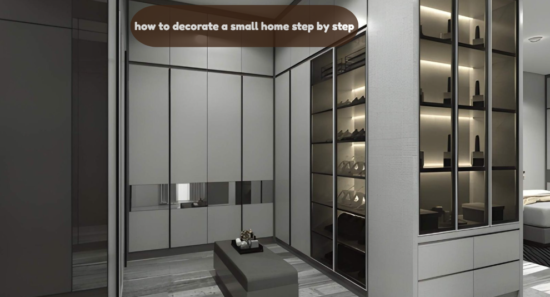
In most small homes, the floor is prime real estate, and the upper walls are completely ignored. That imbalance is where clutter comes from. Visit decoratoradvice com for practical home decorating tips, design inspiration, and expert advice for every room.
A 2024 Architectural Digest reader survey found that small-apartment residents who utilized wall-mounted storage above six feet reported higher space satisfaction scores than those who kept all storage below that line — not because they gained square footage, but because their floors felt more open.
Tall bookshelves, wall-mounted cabinets, floating shelves near the ceiling for seasonal items — these all solve the storage problem without eating floor space.
Step 6: Add Warmth in Layers, Not All at Once
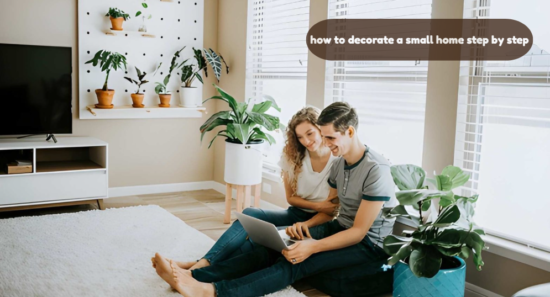
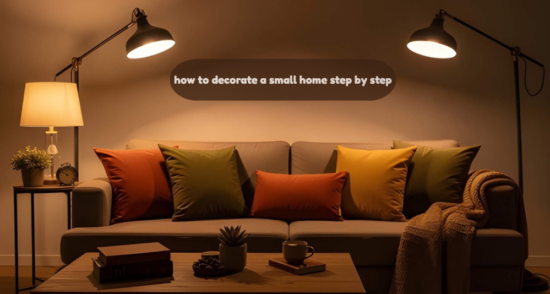
In a small space, the layering principle is one quality rug, two to three coordinated cushions, one throw, and one or two plants with organic shapes. That’s usually enough. Each piece should be deliberate. The mistake is adding warm items the same way you’d add them to a large room—just scaled down. That still adds too much visual noise.
Sarah, a friend of mine in Chicago who lives in a 450-square-foot apartment on the north side of the city, spent two years adding things to her living room trying to make it feel cozy. Nothing worked until she took half of it out and replaced it with one good rug, a pair of plants, and better lighting. The room didn’t change in size. It changed in feeling.
Comparison: Common Small-Space Decorating Approaches
| Approach | What It Gets Right | What It Gets Wrong | Overall Effectiveness |
| Minimalist / Empty | Feels open and calm | Can feel cold, impersonal | Medium |
| Buy smaller furniture | Reduces scale issues | Often looks cheap or flimsy | Medium |
| Pack vertical storage | Frees floor space | Can feel overwhelming if overdone | High |
| Cohesive color palette | Unifies the space visually | Needs planning up front | High |
| Mirrors + light strategy | Major impact, low cost | Easy to place wrong | High |
| Floating furniture layout | Creates breathing room | Counterintuitive for most people | Very High |
The Honest Truth About Small-Space Decorating
It’s not about buying better things. It’s about making decisions in the right order. Clear first. Color second. Layout third. Storage up. Warmth last.
I’ve watched people spend thousands on new furniture and still feel cramped because they skipped many steps And I’ve seen a $400 total refresh—new paint, a mirror, and a rug—completely transform how a space feels because the sequence was right.
What to do next: Pick one room — just one. Start with the assessment in Step 1. Sit in it. Look at it without trying to fix it immediately. Then work through the steps in order. Don’t skip shopping. The clarity you get from the first two steps will save you money and frustration on every decision that follows.
This guide explains how to decorate a small home step by step using practical ideas that maximize space and improve functionality.