
Cabinet Door Styles Explained: Shaker, Slab, and Everything Between
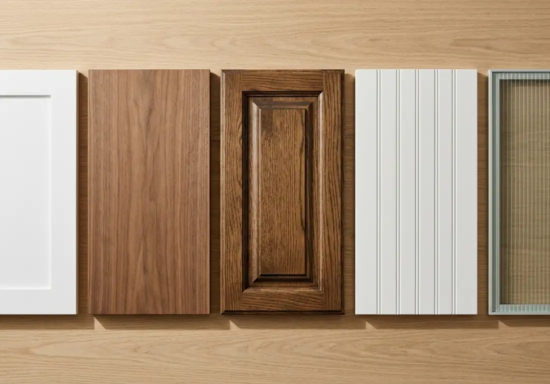
Cabinet doors cover most of the visible surface in a kitchen. They set the style of the room more than the countertop, the backsplash, or the paint colour. And unlike those three, they are the expensive thing to change your mind about.
Here are the styles worth knowing, and what living with each one is actually like.
Shaker
A flat centre panel inside a simple square frame. No curves, no detail, no fuss.
Shaker has been the default for a decade for good reason. It reads traditional in an older home and modern in a new one, it works in any colour, and it does not look like a specific year. If you are worried about your kitchen dating, this is the safe answer.
The trade-off is a small ledge where the panel meets the frame. It collects dust and cooking grease and needs a cloth run along it every few weeks. Minor, but real.
Slab
One flat piece. No frame, no panel, no profile.
Slab doors are the cleanest style to live with. There is nowhere for anything to collect, so a wipe with a damp cloth genuinely finishes the job. In a small kitchen, the uninterrupted surface makes the room read larger.
The catch is that slab shows everything the panel underneath is doing. Any bow, any seam, any unevenness in the finish is visible because there is no detail to distract the eye. Slab is the style where material quality shows most.
Raised panel
The centre panel steps forward with a shaped profile around it. This is the traditional style most people picture when they imagine a wooden kitchen.
It suits period homes and larger rooms and it looks generous. In a small or dark kitchen it can feel heavy, and in a bright colour it can tip from traditional into fussy. It is also the most work to clean, since every profile line is somewhere for grease to sit.
Beadboard and V-groove
Vertical grooves in the centre panel. Cottage, coastal, farmhouse.
Charming in the right house and instantly dated in the wrong one. Also the hardest style to clean properly, because each groove needs individual attention. Worth it if the style of the house asks for it, and a poor choice if you picked it from a photo.
Glass-front and display doors
Not really a style so much as a decision about what to reveal.
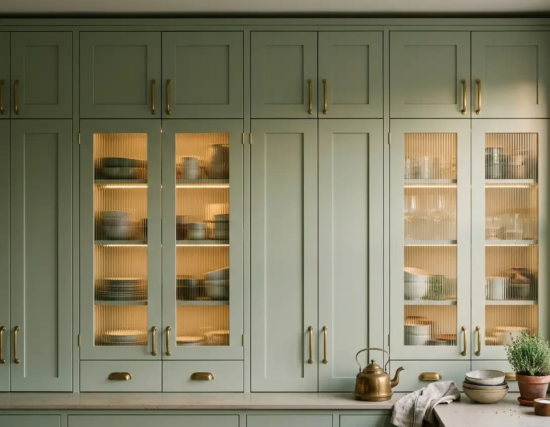
A run of solid doors with one or two glass-front units breaks up a wall of cabinetry and gives a kitchen somewhere to breathe. Clear glass demands that the inside stay tidy, so it works best over a small, curated set of dishes. Reeded, fluted, or seeded glass hides the contents while still lifting the wall, which is why it has become the more popular choice.
If you are working out where a display unit fits in your layout, there are some good examples worth looking through before you commit to a full run of solid doors. The usual mistake is putting glass everywhere. One or two well-placed units do the whole job.
Two-tone
Different styles or colours on upper and lower cabinets. Usually a darker or wood-toned base with lighter uppers.
This works when the two are genuinely different in weight, so the eye reads it as intentional. Two similar mid-tones read as a mistake. It also lets you spend the visual budget where it matters and keep the rest quiet.
How to actually choose
Start with the house, not the trend. A 1920s semi and a new build want different things. Fighting the architecture of a room rarely reads as bold, it reads as unresolved.
Be honest about cleaning. If nobody in the house wipes a ledge, do not buy a style with ledges. This one sentence eliminates half the options for most households.
Look at the kitchen’s light. Deep profiles cast shadows. In a north-facing or windowless kitchen, that makes the room feel smaller than it is. Flatter styles bounce light.
Get samples in the actual room. A door sample in a showroom under bright ceiling lights is not the same door in your kitchen at seven in the evening. Take two or three home and live with them for a week.
Doors are the part of a kitchen you touch every day and look at constantly. Spending an extra week on this decision is one of the better uses of time in a renovation.