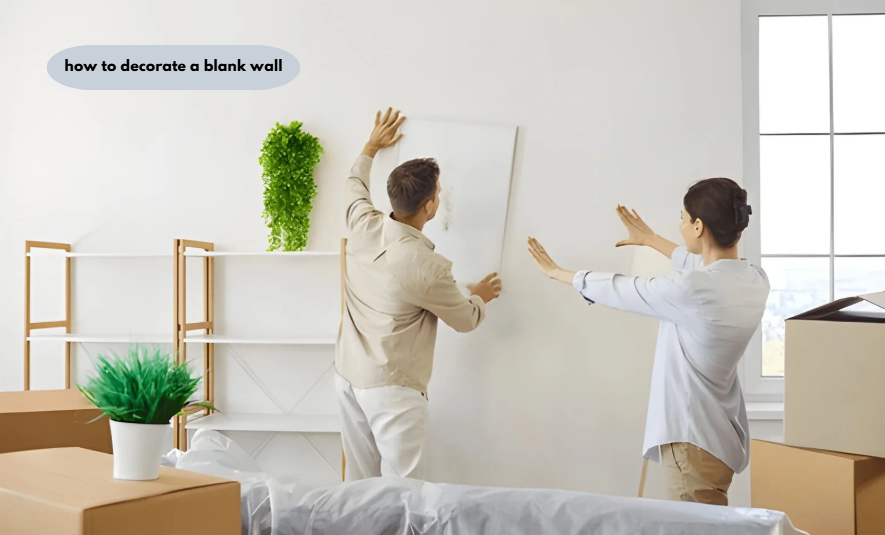
How to Decorate a Blank Wall: 7 Brilliant Ideas Without Clutter
The best answer to how to decorate a blank wall is to pick one focal treatment and size it to fill 60 to 75 percent of the wall’s width. Choose from oversized art, a tight grid gallery, a picture ledge, a mirror, a paint block, a framed TV, or sconces.
Key Takeaways
- A single focal point on each wall looks tidier than a scattering of small, mismatched pieces.
- Art above furniture looks balanced when it spans about two-thirds of the furniture’s width.
- On a bare wall, hang art so its center sits 57 inches from the floor.
- Spacing frames 2 to 4 inches apart makes a grouping look like one cohesive piece.
- A wall-mounted TV looks deliberate when its cables are hidden and its screen center sits at seated eye level.
How to decorate a blank wall without creating clutter?
Pick one role for the wall, then resist filling the rest of it. Clutter comes from scattered small objects, so the fix is fewer, larger pieces with consistent spacing.
Before you buy anything, map out the wall in this sequence:
- Measure how wide and tall the wall is, and make a note of any furniture sitting beneath it.
- Multiply the width by 0.6 and 0.75 to get your target coverage range.
- Choose one treatment from the seven below.
- Cut kraft paper to the size of each piece and tape it up for 24 hours.
- Shift the paper around until the gaps look uniform, then hang the pieces.
If your question is how to upgrade my home on a small budget, a wall is the cheapest place to start. Homeowners who renovated in 2025 spent a median of $20,000, according to the 2026 U.S. Houzz & Home Study. At $200, a wall project comes to just 1 percent of that figure, yet it transforms the first thing people notice when they walk into the room.
What are the 7 best ideas for a blank wall?
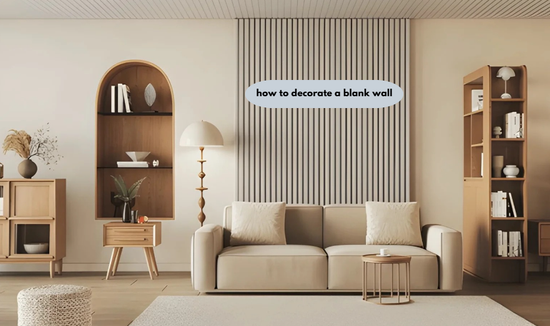
The seven ideas below each rely on one strong element and no extra accessories. Most are simple wall decor ideas that look clean and modern because they repeat one shape, one frame color, or one material.
1. One oversized piece
A single large artwork fills a wall with the fewest objects possible. Choose a piece at least 36 inches wide for a wall above a sofa or bed, and skip side pieces entirely.
2. A tight grid gallery
A tight grid gallery uses identical frames in even rows, so six or nine pictures read as one rectangle. Keep every gap the same, between 2 and 3 inches.
3. A picture ledge
A picture ledge holds layered frames on one shelf, so you make two or three screw holes instead of ten. Limit the ledge to five items and vary the frame heights.
4. A large mirror
A mirror 30 inches wide or more brings in light and depth without creating visual clutter. Place it opposite or beside a window, never facing a messy area.
5. A paint block or half wall
A painted rectangle or a band of color running halfway up the wall adds decoration without hanging a single thing. Stop a half wall at 36 to 42 inches from the floor to match typical chair-rail height.
6. A framed TV wall
A television turns into decor once it’s mounted flush, framed, and has no cords showing. Treat it as the wall’s single focal point and keep shelves away from it.
7. Plug-in sconces
A pair of plug-in sconces decorates a wall with light instead of objects. Mount them 60 to 66 inches from the floor and run the cords through paintable cord covers.
How do you size and hang wall art so it looks intentional?
Match the size of the art to the furniture beneath it, then set its height from either the floor or the furniture, depending on the wall. Two rules cover most rooms: two-thirds width above furniture and a 57-inch center on open walls.
A worked example above a sofa
Three 16-inch frames with 4-inch gaps fit an 84-inch sofa exactly. Here is the math:
- Sofa width: 84 inches
- Target art width: 84 × 2/3 = 56 inches
- Three frames at 16 inches: 48 inches
- Two gaps at 4 inches: 8 inches
- Total: 48 + 8 = 56 inches
Hang the bottom edge of the frames 8 inches above the sofa back. Above furniture, this gap rule replaces the 57-inch rule.
Gallery walls on narrow walls
A 3-by-2 grid of small frames suits a narrow wall better than a loose, organic layout. Here is how to create a gallery wall in a small space using a 48-inch wall:
- Six frames, each 10 inches wide and 12 inches tall
- Width: (3 × 10) + (2 × 2-inch gaps) = 34 inches
- Height: (2 × 12) + (1 × 2-inch gap) = 26 inches
- Coverage: 34 ÷ 48 = 71 percent of the wall’s width
The most common mistake and its fix
The most common mistake is hanging art too high, because people measure from the ceiling or hold the frame at standing eye level. The usual decoratoradvice is to hang at eye level, which fails when nobody defines whose eyes.
Use a fixed number instead. For a frame 20 inches tall with its hanger 2 inches below the top edge, the hook goes at 57 + 10 − 2 = 65 inches from the floor.
Renters can skip nails for lighter pieces. Four pairs of Command Large Picture Hanging Strips support a frame of up to 16 pounds and 24 by 36 inches, according to 3M’s product specifications. Weigh each frame on a bathroom scale first, and move to a wall anchor for anything heavier.
What are the best ways to decorate a TV wall?
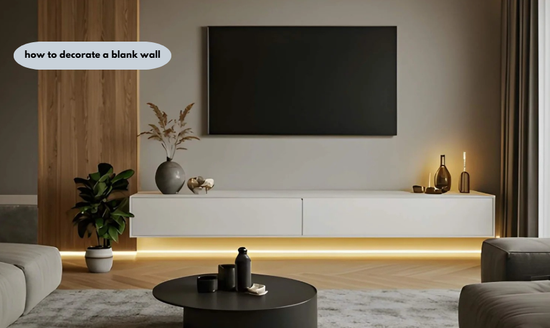
Mount the TV with its screen center about 42 inches from the floor, hide every cable, and keep the surrounding wall almost empty. The strongest TV wall decor ideas use one low console, one paint color behind the screen, and nothing else.
Painting the wall behind the TV a dark, matte color makes the black screen blend in when it is off. A console that is wider than the TV by at least 6 inches on each side anchors the screen visually.
An art-mode television is the one home device that doubles as wall art, since it shows a painting or photo when idle. Size it to your seating distance before choosing a model. Samsung recommends a viewing distance equal to 1.2 times the diagonal measurement of the screen. So if your sofa sits 78 inches from the wall, a 65-inch TV is the right match, and at 66 inches, a 55-inch TV works best.
| Screen size | Seating distance (size × 1.2) | 2025 U.S. launch price, art-mode model | Source |
| 43 inches | 51.6 inches (4.3 feet) | $899 | Samsung Electronics America |
| 55 inches | 66 inches (5.5 feet) | $1,299 | Samsung Electronics America |
| 65 inches | 78 inches (6.5 feet) | $1,799 | Samsung Electronics America |
When does the usual advice not apply?
The 57-inch rule and adhesive strips can both fail in certain rooms, so choose your approach based on the wall and ceiling height. Adhesive strips may not hold securely on textured plaster, brick, or wallpaper, so use a picture rail, a floor-leaning frame, or suitable masonry anchors instead. In rooms where the ceiling is higher than 10 feet, lift the center of the artwork to around 60 inches, or stack two pieces one above the other to use the added wall space. In a dining room, where people are mostly sitting down, drop the center to roughly 54 inches. These simple decoration tips help keep wall art balanced and suited to the room.
Frequently Asked Questions
What is the cheapest way to fill a large empty wall?
Paint is the cheapest way to fill a large empty wall, since one quart covers a color block or half wall. A painted rectangle behind a bench or bed acts as a headboard or backdrop with no hardware.
How high should pictures hang on a wall?
The center of a picture should sit 57 inches from the floor if it’s going on an open wall. Above a sofa, console, or bed, set the bottom edge 6 to 10 inches above the furniture instead.
How many pictures are too many for one wall?
More than nine frames on one standard wall usually looks cluttered unless the frames match. Identical frames and even spacing allow a bigger grouping to come across as a single shape, whereas mismatched frames work better in smaller numbers.
Should every wall in a room be decorated?
No, at least one wall in each room should stay empty or nearly empty. Blank space gives the eye a rest and makes the decorated wall stand out more.
Can you decorate a rental wall without drilling holes?
Yes. Adhesive strips, picture ledges placed on furniture you already have, leaning mirrors, and plug-in lights all do the job with no drilling. Check the weight rating on any adhesive product and test it on smooth, painted drywall only.
Conclusion
Knowing how to decorate a blank wall comes down to one focal treatment, sized to 60 to 75 percent of the wall’s width, with empty space around it. Measure first, tape up paper templates, and hang by the numbers. The most useful decoration tips are the ones that remove items from the wall, not add them.