How to Hang Garland on Stairs Without Damage: 9 Easy No-Drill Methods
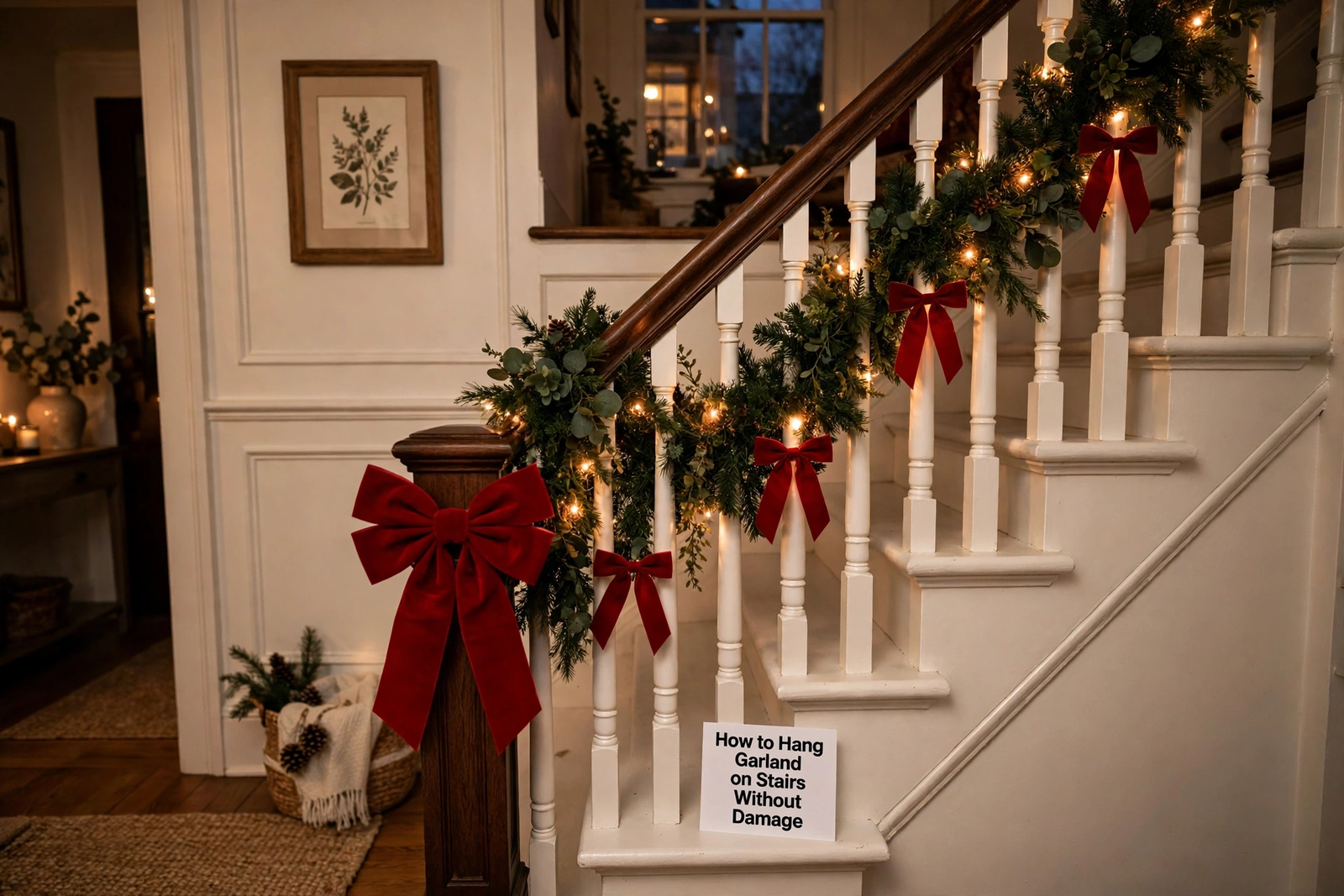
A garland-draped staircase is one of the prettiest parts of holiday decorating, as long as your banister still looks good when the season’s over. If you’re wondering how to hang garland on stairs without damage, here’s the secret: tie, clamp, or stick, but never drill. Below, I’ll walk you through each method so your stairs look festive now and stay flawless later.
Key Takeaways
- Soft ties wrapped around balusters hold garland firmly without touching the handrail’s finish.
- Removable adhesive hooks grip sealed wood and cured paint but fail on raw, oiled, or textured surfaces.
- A heavy pre-lit garland needs a tie point every 12 to 18 inches to prevent sagging.
- Most banister marks appear during removal, when strips get pulled outward or ties get sliced off with a blade.
We tested these methods on a sealed oak banister over two holiday seasons; velvet ribbon and felt-padded zip ties left zero marks.
What Is No-Drill Stair Garland Hanging?
No-drill stair garland hanging is any method that holds greenery to a railing, baluster, or newel post through ties, padded pressure, or removable adhesive, leaving no holes or residue afterward.
How to Hang Garland on Stairs Without Damage: 9 No-Drill Methods
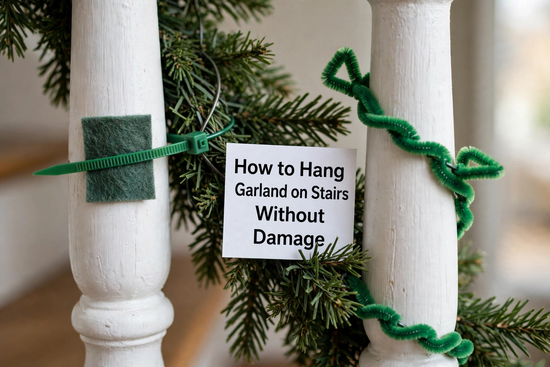
Choose by railing material first and the garland weight second. Most staircases need two methods: baluster ties for the run, plus hooks or clamps at the posts.
1. Zip Ties Over Felt Pads
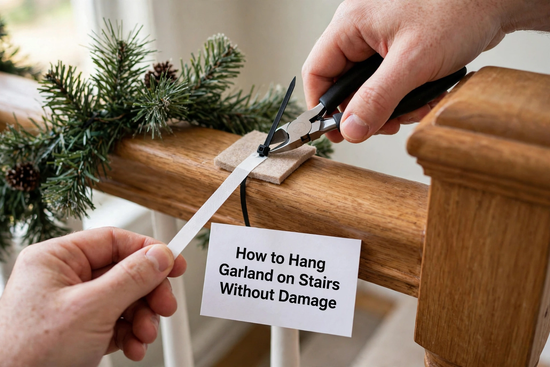
Zip ties grip harder than any other no-drill option, provided felt sits between plastic and wood. Use 8-inch ties in green or clear, stick a 1-inch felt square where each one lands, and cinch only until the garland stops sliding.
2. Velvet or Wired Ribbon
Ribbon fastens and decorates in one step. Tie 2-inch velvet at every second or third baluster; its pile grips the spindle and slips far less than satin.
3. Green Pipe Cleaners
Pipe cleaners vanish into fire tips and suit garlands under about 3 pounds. Fold each cut end back, because bare wire scratches lacquer.
4. Removable Adhesive Hooks on Newel Posts
Adhesive hooks belong on newel posts, where garland ends and bows anchor. Clean with rubbing alcohol, press the strip for 30 seconds, and wait an hour before loading; skip raw or oiled wood, and paint applied less than 7 days ago.
5. Clear Cord Clips Under the Handrail
Clear adhesive cord clips mounted under the rail carry light faux garland and light strands out of sight. Clean the underside with rubbing alcohol, space the clips about 12 inches apart, and press each one for 30 seconds.
Check the weight rating on the package, since these clips suit only the lightest greenery. Never place them on top of the rail, where sliding hands catch them.
6. Padded Spring Clamps
Spring clamps suit thick, rounded handrails that ties can’t circle neatly. Tape the jaws twice, then clamp the garland’s wire core to the rail’s outer edge.
7. Purpose-Made Banister Straps
Banister straps are hook-and-loop bands sized for stair rails, and they release without tools. Choose fabric-backed versions, since bare rubber dulls warm lacquer.
8. Clamp-On Post Hangers
Clamp-on hangers grip a newel cap with a padded screw and carry a heavy swag or wreath. The same hanger doubles as a stocking holder, which makes the staircase one of the easiest answers if you’re working out how to hang stockings without a mantel: One hanger per post keeps a filled stocking well clear of the treads.
9. Hidden Fishing Line Loops
Clear fishing line fixes sag between tie points without adding visible hardware. Cut a 12-inch length of 20-pound monofilament, loop it around the rail and the garland’s center wire at the lowest point of the sag, pull until the garland sits level, and knot it twice. Trim the ends to a quarter inch so they don’t catch on sleeves.
How Many Tie Points Does a Stair Garland Need?
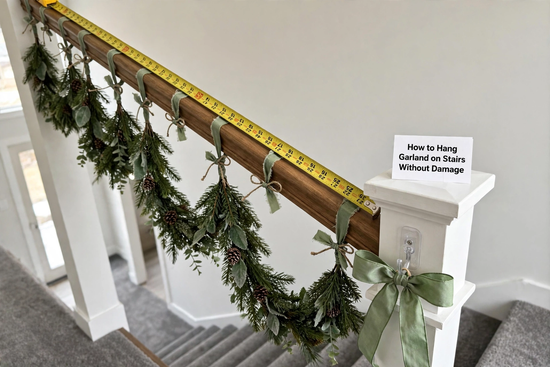
Plan one tie point every 12 to 18 inches for pre-lit or real garland and every 24 inches for light faux greenery. Weigh it first: hold the garland on a bathroom scale and subtract your own weight.
A worked example for a 12-foot handrail:
- A pre-lit garland at 6 pounds plus 1.5 pounds of bows equals 7.5 pounds.
- At 15-inch spacing, 144 ÷ 15 = 9.6, rounded up to 10 spans and 11 tie points.
- Each tie carries 7.5 ÷ 11, or about 0.7 pounds.
The posts carry more. A Command Large Utility Hook holds up to 5 pounds, according to 3M’s product listing. If each garland end puts 1.5 pounds on its post and a 2-pound bow hangs there too, the hook keeps 1.5 pounds of headroom, so one large hook per post is enough.
For swags, a common decorator rule puts a tie at every peak, roughly every 3 to 4 feet, with fishing line under any swag deeper than 10 inches.
Which No-Drill Method Fits Your Railing?
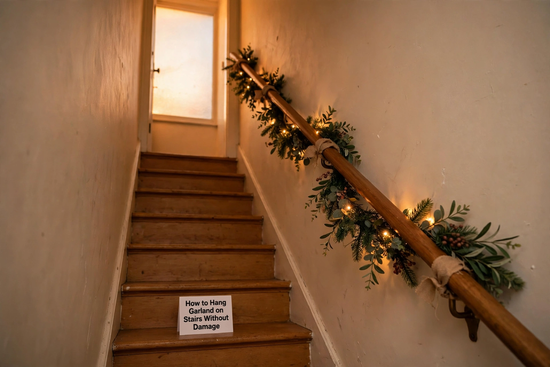
Match the method to the surface first. Sealed oak accepts almost anything, while antique or waxed wood limits you to fabric ties and padded clamps.
| Method | Best Surface | Garland Weight | Removal Risk | Reusable |
| Zip ties over felt | Wood or metal balusters | Heavy | Low with flush cutters | No |
| Velvet ribbon | Any baluster, even raw wood | Light to medium | Very low | Yes |
| Pipe cleaners | Painted or sealed spindles | Light | Low | Partly |
| Adhesive hooks | Sealed newel posts | Medium | Medium | Hook only |
| Clear cord clips | Rail underside | Very light | Medium | Clip only |
| Padded clamps | Thick rounded rails | Medium | Low | Yes |
| Banister straps | Most rails | Medium | Very low | Yes |
| Post hangers | Square posts with cap overhang | Heavy swags | Low | Yes |
| Fishing line | Any rail | Support only | Very low | No |
Enclosed staircases need a different approach, since walls flank both sides and there are no balusters to tie to. Wrap a slim garland, under about 6 inches thick, around the wall-mounted handrail and secure it with ribbon ties between the brackets so a hand still closes fully around the rail. For more ways to dress a walled-in staircase, from wall swags to step-edge lighting, browse these enclosed stairway decorating ideas.
How Do You Make a Stair Garland Look Full?
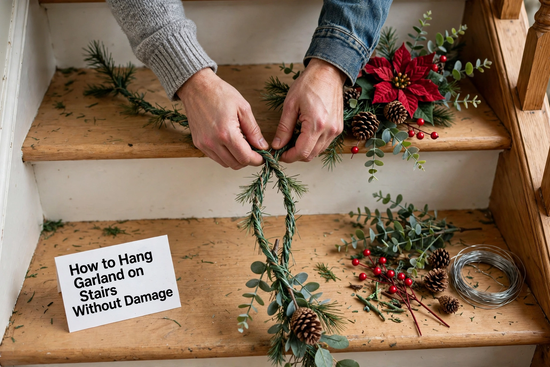
Two thin, cheap garlands twisted together look fuller than one thick one and cost less—twist them loosely so their wire cores lock.
Then fluff each branch tip up, out, and down. That step alone makes most faux garlands look twice as dense.
Add filler stems every 12 inches: eucalyptus, pine cones, berry picks, or a faux poinsettia, the Mexican flower that became a holiday staple. Wire stems to the garland’s core, never to the balusters.
What Mistakes Damage a Banister When the Garland Comes Down?
At DecoratorAdvice we see the same four habits behind almost every January banister mark. Here’s how to avoid each one.
- Pulling adhesive strips outward. Stretch the tab slowly straight down, parallel to the surface, until it releases.
- Slicing zip ties with a utility knife. Use flush cutters angled away from the wood.
- Leaving fresh greenery on bare finish. Cedar and pine weep sap for weeks. Lay wax paper where garland touches stained wood, or switch to faux.
- Reaching across the rail from the treads. Nearly half of the roughly 14,900 holiday decorating injuries treated in U.S. emergency departments during the 2022–23 season involved falls, according to the U.S. Consumer Product Safety Commission (CPSC). Work from the step directly below each tie point, both feet planted on one tread.
How Do You Keep a Lit Stair Garland Safe?
Use indoor lights with a UL or ETL listing, keep cords off the treads, and switch everything off at bedtime. Battery strings with timers solve most cord problems.
U.S. fire departments responded to an average of 835 home structure fires a year that began with decorations, Christmas trees excluded, between 2018 and 2022, per the National Fire Protection Association. LED strings, which run far cooler than incandescent minis, and an outlet timer cut that risk on a staircase you pass all day.
Whatever look you choose, don’t let the greenery block the grip: wherever hands slide along the rail, move the garland to the rail’s outer side. Our full guide has more decoration tips for stairs that balance style with safety.
Frequently Asked Questions
Can command hooks damage a stair railing?
Command hooks rarely damage sealed wood or cured paint when removed correctly. Trouble starts on raw wood or fresh paint or when someone pulls the strip outward.
How do you keep garland from sagging on a banister?
Add tie points and lift low spots with clear fishing line. Sag usually means ties sit more than 18 inches apart.
Can you hang stockings from a staircase?
Yes, newel posts and sturdy balusters make good stocking anchors. Keep each stocking above the tread line so nobody trips.
How long should a garland be for a staircase?
A 12-foot rail takes about 18 feet of garland for a gentle drape, and up to 24 feet if you want deep swags—roughly one-and-a-half to two times the handrail length.
Is real or faux garland better for stairs?
Faux garland is safer for stained or antique banisters. Real greenery sheds needles on treads and leaks sap.
How do you hang garland on a wrought-iron or metal railing?
Zip ties over felt pads work well on iron balusters, and magnetic hooks grip solid iron without any adhesive. Skip magnets on aluminum railings, since they won’t hold.
Conclusion
Knowing how to hang garland on stairs without damage means choosing ties, clamps, and removable adhesive over nails, then spacing attachment points to match the garland’s weight. Pad every contact point and peel strips straight down, and the banister looks untouched in January.