Bookshelf Decor Ideas: 15 Practical Ways to Style Shelves Beautifully
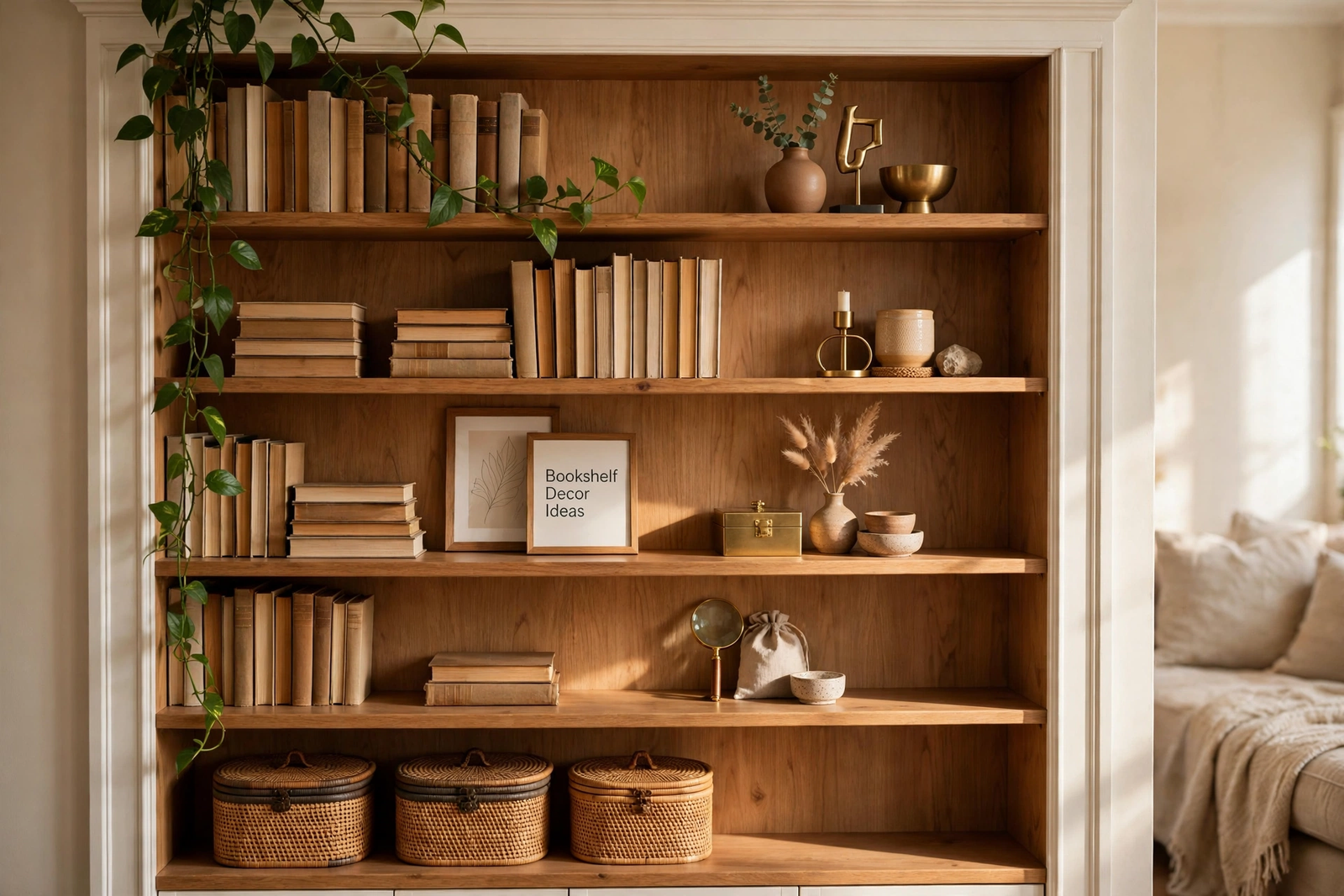
The best bookshelf decor ideas mix books with a few objects you love, leave a third of each shelf empty, and repeat colors so everything feels intentional. Arrange things in odd numbers, play with heights, and never exceed each shelf’s weight limit.
Key Takeaways
- A styled bookshelf works best with roughly two-thirds of each shelf filled and one-third left open.
- Odd-numbered groupings of three or five objects look more natural than pairs or long rows.
- Hidden-bracket floating shelves often carry far less weight per inch than a bookcase, so they suit decor more than full rows of books.
- Most shelf styling costs nothing, because the objects already sit in other rooms.
- Warm LED lighting at 2700K to 3000K makes shelf objects look richer than cool daylight bulbs.
- A freestanding bookcase taller than it is wide needs a strap anchored into a wall stud.
What are the best bookshelf decor ideas?
Start with structure, then add personality. These 15 ideas build on each other, so they work best in this order:
- Empty everything first. You can’t see a shelf’s shape while it’s full.
- Plan a visual triangle. Put your three tallest items on different shelves so the eye zigzags down the unit.
- Mix vertical and horizontal stacks. Lay five books flat, then stand the next run upright.
- Use a flat stack as a riser. A small vase or candle sitting on three horizontal books gains instant height.
- Color-block by spine. Sort jackets into warm, cool, and neutral zones rather than a full rainbow.
- Turn spines inward sparingly. One shelf of page edges calms a busy unit; a whole case hides every title.
- Group in threes. A tall piece, a medium piece, and a low piece form a balanced cluster.
- Add one living thing. Trailing pothos tolerates shelf-level light and softens hard edges. It’s toxic to cats and dogs, so pet owners can swap in a spider plant or Boston fern.
- Lean art behind objects. A small framed print propped at the back creates depth without nails.
- Repeat a material. Brass, rattan, or matte ceramic appearing on three shelves ties the whole case together.
- Hide clutter in baskets. Lidded bins on bottom shelves swallow chargers and paperwork.
- Leave negative space. Bare wood between groupings lets each piece read clearly.
- Anchor the base. Heavy items go low, where they look grounded and add stability.
- Use weighted bookends. Marble or cast-iron ends stop upright rows from slumping into a lean.
- Edit seasonally. Swap two or three objects each season so the shelf never goes stale.
What mistakes make a bookshelf look cluttered?

Too many small objects cause most clutter. As a rule of thumb, anything shorter than about 4 inches (10 cm) disappears from across the room and reads as a mess.
Two other errors show up constantly. Books pushed flush with the front edge flatten the shelf, so set rows back an inch and let objects sit forward. A bare top shelf looks unfinished; one tall piece there sets the height line. The best decoratoradvice tip for all three problems is the same: remove one item after you think you’re finished, then step back 10 feet and judge again.
How much weight can a floating shelf hold?
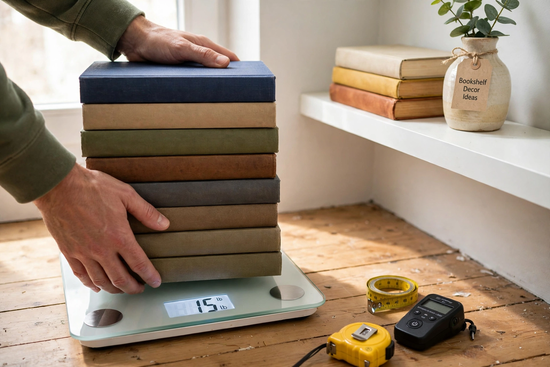
Far less than most people assume. Hidden brackets give it a much lower rated capacity per inch than a standard bookcase shelf.
| Shelf | Rated max load | Approx. width | Load per inch (calculated) | Source |
| IKEA BILLY shelf, 80 cm unit | 30 kg (66 lb) | 31.5 in | About 2.1 lb | IKEA BILLY bookcase product specifications |
| IKEA BILLY shelf, 40 cm unit | 14 kg (31 lb) | 15.7 in | About 2.0 lb | IKEA BILLY bookcase product specifications |
| IKEA LACK wall shelf, 110×26 cm | 10 kg (22 lb) | 43.3 in | About 0.5 lb | IKEA LACK wall shelf product specifications |
Run the math. The floating shelf supports roughly a quarter of the per-inch load of the bookcase shelf, even though it stretches nearly 12 inches longer.
The common mistake: treating a floating shelf like a bookcase
People fill floating shelves edge to edge with hardcovers because the shelf looks sturdy. Months later it sags and the anchors pull loose.
The fix takes one bathroom scale. Weigh a 12-inch run of your own books. Say it comes to 15 pounds, or 1.25 pounds per inch; on a 22-pound floating shelf, that row maxes out around 17 inches with nothing else on board. Keep floating shelf decor to a short book stack, one ceramic piece, and a plant, and screw brackets into studs whenever spacing allows.
How do you style a room with what you already have?
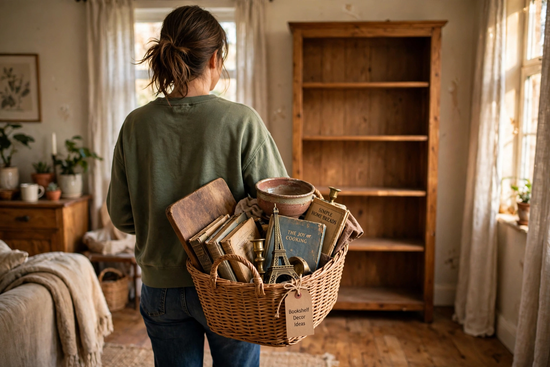
Shop your own house before you shop a store. The easiest way to learn how to style a room with what you already have is to grab an empty laundry basket and walk through every room, collecting anything with an interesting shape, texture, or story.
Think wooden cutting boards, vintage cookbooks, travel souvenirs, and a pottery bowl. Audition each one on the shelf; anything that doesn’t earn its spot goes back. Store the rejects in a bin for next season’s swap.
That habit pays off while renovation budgets stay tight. The Harvard Joint Center for Housing Studies expects U.S. homeowner remodeling spending to stay largely flat, at about $524 billion to $527 billion, through late 2027. A shelf refresh built from objects you already own delivers a visible change for zero dollars, leaving your budget for repairs that need a contractor.
How do you turn a bookcase into a reading nook?
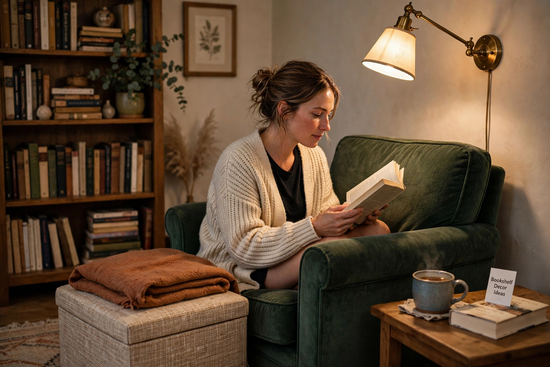
Pair the bookcase with a chair, a lamp, and a small surface for a drink. Those three additions convert a storage wall into a place you actually sit.
Physical books still justify the effort. A Pew Research Center survey from October 2025 found that 64% of U.S. adults had read a print book in the past 12 months. If you fall into that group, put your current reads and to-be-read pile at seated eye level, roughly the second and third shelves, so you never stand up to grab the next title.
The best reading nook ideas solve comfort and light together. Aim a swing-arm sconce over the reader’s shoulder, not straight ahead. A storage footstool holds a throw blanket and keeps the floor clear.
How do you light a bookshelf?
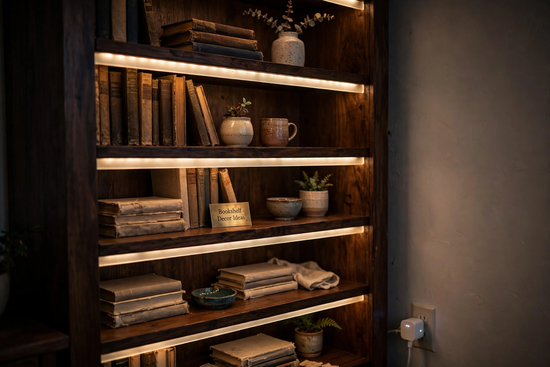
Mount warm LED strips at the front edge of each shelf, aimed back toward the objects. Rear-mounted strips mostly light the wall instead of the display.
Choose 2700K to 3000K strips, which flatter wood, paper, and ceramics, and run them inside a frosted aluminum channel so LED dots never show. Renters can skip wiring with rechargeable adhesive puck lights.
Shelf lighting is one of the simplest smart home ideas to set up. Plug the strip into a smart plug, schedule it to switch on at sunset, and dim it to 30% after 9 p.m.
How do you keep a styled bookcase from tipping over?
Anchor it to a wall stud with a metal strap or bracket, and keep heavy objects on the lowest shelves. Decor raises the risk, because a tall vase or framed art near the top shifts the center of gravity forward.
The danger is real. The U.S. Consumer Product Safety Commission’s 2023 tip-over report estimated an annual average of 17,800 emergency department visits linked to TV, furniture, and appliance tip-overs. Check your anchor by pulling firmly on the top edge; if the case shifts even half an inch, locate a stud with a finder and reinstall the strap before adding another object.
In any home with toddlers, also skip decor on the lower shelves that invites climbing, such as candy dishes or favorite toys.
When does the usual shelf-styling advice not apply?
Working libraries break the rules. If you pull books daily for research or teaching, the one-third-empty guideline wastes space you need. Shelve by subject, fill every inch, and limit decor to the top shelf and row ends.
Frequently Asked Questions
How many items should go on one bookshelf?
Stick to three to five groupings per shelf, counting books as one. Leave a little breathing room between them.
Should books be arranged by color?
Arrange by color only if you rarely search for specific titles. Heavy readers find books faster by subject or author.
What do you put on a bookshelf besides books?
Plants, small framed art, ceramics, baskets, and souvenirs work well. Pick varied heights and textures to contrast with flat book spines.
How do you make a bookshelf look expensive?
Limit the palette to two or three colors and repeat one material across several shelves. Removing dust jackets to reveal plain cloth covers also adds a quiet, high-end look.
How high should you hang floating shelves?
Hang the lowest shelf about 12 to 18 inches above a sofa or desk surface. Space more shelves 10 to 14 inches apart, depending on the tallest object you plan to display.
Conclusion
Strong bookshelf decor ideas rest on three habits: leave open space, group in odd numbers, and respect what the shelf can hold. Start with the objects you already own, anchor anything tall, and edit until every piece has a reason to stay.