
How to Create a Cohesive Backyard: Matching Patios, Planting, Lighting, and Furniture
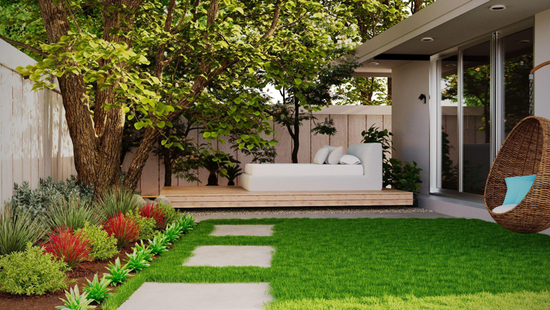
Most of us build our backyard a little at a time. First, we put out the table. We get some hostas from the neighbour. Someone gives us some string lights as a gift. We may have all kinds of stuff out in our backyard after five years, but it may not really all go together.
The good news is that your backyard doesn’t need a huge budget or a complete overhaul to be more cohesive. You just need a plan, and a few simple guidelines. Sketching out a plan is a great place to start, and it’s also free. Programs like GardenBox 3D allow you to actually map out your patio, garden beds, and seating before you buy anything. That way, you can see if things clash or don’t work well before you spend any money.
Now that we’ve got that covered, let’s take a look at each element of your backyard and see what we can do to come up with a balanced design that is just right for your space.
Have a theme
Any good-looking backyard has a theme to it, even if you never consciously decided on one. Decide on a theme before you do anything else, and make sure that you are consistent with it. Here’s some ideas of themes to get you started:
- Relaxed and woody, like a cabin in the woods
- Clean and modern, with crisp lines
- Soft and cottagey, with lots of blooming flowers
- Mediterranean style, with lots of stone and plants with silvery foliage
Write your theme down on a piece of paper, or stick a note to the front of your credit card. Whenever you’re at a garden centre, stop and ask yourself if the item fits your theme. Chances are, if you’re thinking of buying something on the spur of the moment, it will probably not fit your theme. That’s a good thing!
Start with what you have
Every backyard has a few things that can’t be moved. These are the things you have to work with. Whether it’s the colour of your house, or an old oak tree, these are the things that set the palette for your backyard.
Take a look at your house first. If you have a warm coloured brick house, then choose materials and plants that are also warm (like cream, terracotta and deep greens). If you have a rendered (painted) house, with a colour like grey, choose things that are a little more cool, like stones with cool colours, blue-tinted plants, and black metal. If you have a house with a more yellow/tan colour, go with warmer materials like wood in honey colours, and add some rusty coloured accents.
Next, take a look at the sun and shade in your yard. Is there a corner of your backyard that is in the sun at 6 pm? That’s a great place for a dining table. Is there a shady corner of the yard? That’s a great place for a bench and some shady plants, like ferns. Work with what you have by putting things in the yard where they make the most sense.
Patio: set the tone
The patio sets the tone for the rest of your backyard. It’s the ‘floor’ of your outdoor living room, and as the largest hardscaped surface, its colour and material will influence all of your other choices.
- Start by picking one material for your patio. Natural stone, concrete pavers, brick, or timber decking are all great materials for your patio. Stick with one of these instead of trying to use 3 different materials; it will look like you didn’t make a decision. If you’re using 2 materials in your yard (like a patio and a pathway, for instance), make sure they’re both from the same colour family.
- Next, think about the edges of your patio. Try to avoid a patio that ends in a hard line; instead, soften the edge with plants, gravel, or even lawn. This will help tie your patio area in with the rest of your garden beds and other plantings.
- Finally, size your patio appropriately. A too-small patio can feel cramped, and you don’t want that! For instance, a 10′ by 10′ patio will be about right for a 4-person table, once you take the chairs into account. Make the patio bigger if you also have a grill, sofa set, or other furniture.
Planting: Repeat Yourself
It seems like there is an endless amount of plants out there to choose from. A good way to narrow your selection is to choose a few plants and repeat them throughout the yard.
Select three to five main plants that you want to use and plant each one in at least two different places. Select one to two flower colors to use and add in some white or silver foliage to help calm the color scheme.
Choose plants with different heights such as tall grasses in the back, mid-height shrubs in the middle, and a low ground cover in the front. Try to plant in odd numbers, such as threes, fives, or sevens.
Repetition is important in a garden. If you plant just one lavender plant, it will look like you bought it to fill a space. But if you use lavender plants in three different places, such as near the patio, along the walkway, and by the gate, it will look like a well-thought-out choice.
The same goes for containers. Use a set of pots that are the same color or made of the same material. Three pots, even if they are different sizes, are much better than a selection of six mismatched pots. Use the same plants in your containers that you use in the beds.
Lighting: Keep it Warm and Low
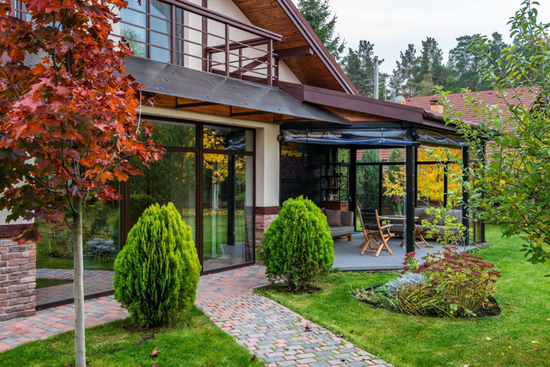
Good lighting can make your outdoor space feel like a continuation of your house, while bad lighting can give it the feel of a parking lot. Try to stick with one color of light bulb throughout your yard. A warm bulb, such as a 2700K bulb, works in most outdoor spaces. Switching from warm to cool colored light bulbs will quickly kill the mood.
- Use layers of light with ambient light (string lights or wall lamps), task lighting (for the grill or steps), and accent lighting (spotlights on a tree or tall grasses).
- Choose a consistent finish for your light fixtures; you can use black, bronze, or brass, but don’t mix them.
- Keep your light fixtures low. Lights above head height can feel harsh, but when the light comes from your knee height, it feels more inviting.
- Solar lights are a great option for paths or walkways. Place them in a consistent pattern so that the spaces between each fixture are the same.
Pick Furniture that Fits
One of the biggest problems with outdoor spaces is the furniture. People tend to just place any outdoor furniture they have in the space, whether it’s a teak bench, plastic chair, and metal bistro set, all placed in the same area. Each piece of furniture is fine on its own, but when you mix and match, it doesn’t work. Pick one main material and one accent material for your outdoor space. For example, teak and black metal are a great classic combination. Or woven rattan with white cushions or powder coated aluminum can work well in a more modern outdoor space.
Outdoor cushions and pillows are a great way to add color to your outdoor space. Pull two colors from your planting scheme and use them on all your cushions. Outdoor fabrics have come a long way and many are fade resistant and suitable for rainy weather. Also, try to pay attention to scale. A large sectional can overpower a small patio. Make sure that there is at least three feet of space to walk around your outdoor furniture.
Small Details to Bring it All Together
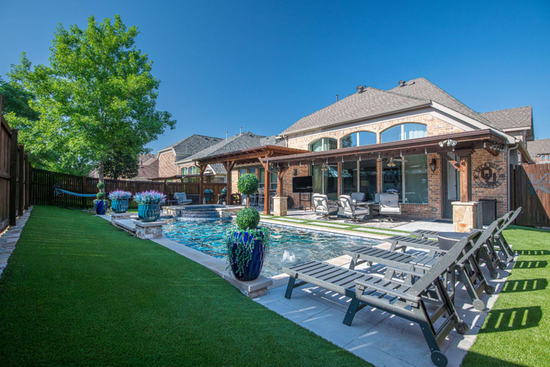
The final touch is all in the small details.
- Choose a rug that complements a color from your planting scheme.
- Use planters that are the same finish as your furniture.
- Make sure that house numbers, the gate latch, and the mailbox all match in metal finish.
- Add a small water bowl or fountain to your seating area.
- Use the same color of pebbles or mulch throughout all of your beds.
The Takeaway
A cohesive backyard comes from restraint. One theme, one or two materials, a short plant list, and a single light color go a long way. Every new item should answer a simple question: does it belong here?
Start small. Fix the patio edge, repeat a few plants, and swap the mismatched bulbs. By the end of the season, the yard will feel like one space instead of a collection of leftovers.