How to Make a Neutral Interior Feel More Interesting
Neutral interiors have plenty going for them. Soft whites, warm greys and sandy beiges feel calm, timeless, and restorative. But without a little planning, a neutral room can turn from serene into flat. The good news is that you don’t need bold paint or loud patterns to fix it. You just need to give your eyes more to enjoy.
Layer in Texture
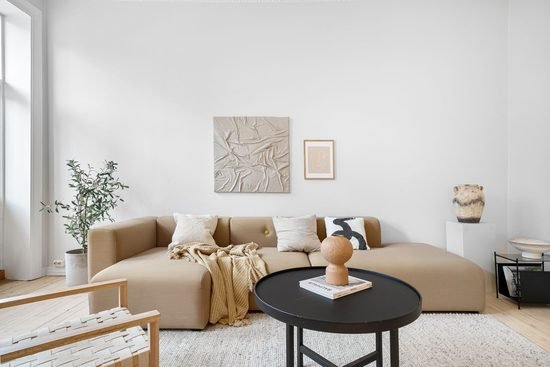
When colour is quiet, texture does the talking. Think of a chunky knit throw over a linen sofa, a bouclé armchair beside a smooth plaster wall, or a woven jute rug to define areas in your open-space living room. Each surface catches light differently, which creates subtle shifts in tone even when everything is technically the same shade.
To add visual interest, try mixing at least three or four textures in a single room, some soft and some rugged, so the space feels layered rather than uniform. Heavy, slubby linen curtains or a ribbed ceramic vase on a shelf are easy places to start.
Play With Contrast
Contrast gives a neutral room its backbone. You don’t have to go full black and white, but introducing a few deeper tones, such as charcoal, espresso brown, or warm taupe, stops everything from blending together.
And it is not all about paint, either. You can do a lot with well-positioned accents. For instance, a dark frame against a pale wall, or black window frames, can sharpen the whole look. You can also contrast finishes: matte against glossy, rough against polished.
Keep the palette limited and repeat one or two darker accents around the room so the effect feels deliberate rather than random.
Choose Natural Materials
Natural materials bring a warmth and authenticity that painted surfaces can’t quite match. Stone, linen, rattan, wool, leather, glass, and wood all add character, and their small imperfections keep a room feeling lived in.
Natural does not have to mean modest. If you are going for more of a quiet luxury touch, a marble tabletop with visible veining or a rough-hewn oak bench can become a focal point without a single bright colour.
When choosing materials, keep in mind that they might influence how relaxed you feel at home. A 2023 study explored the “restorativeness” of home environments, meaning how well a space helps you recover from stress and mental fatigue. Researchers surveyed 85 adults in China with backgrounds in interior design and asked them to rate the restorative potential of different interior materials. Glass came out best, which hints that light, openness and a connection to the outdoors may do a lot for your mood. Wood, often assumed to be the ultimate calming material, raised some doubts, so it’s worth using thoughtfully rather than everywhere. Metal wasn’t recommended for restful spaces.
It’s a small study, but it works well as a reminder to mix materials, let in plenty of daylight, and treat metal as an accent rather than the main event.
Let Artwork Do the Talking
Art is one of the fastest ways to add personality. In a neutral space, even a single large piece of wall art can become the heart of the room. Choose something that reflects you, whether that’s an abstract canvas, a black-and-white photograph, or a vintage print.
If you are looking to add a statement or focal point, keep in mind that oversized work often feels more confident than lots of tiny frames. However, gallery walls can work well when it comes to showcasing your taste, but give it a sleek look by keeping the frames consistent and varying the sizes. Don’t forget three-dimensional pieces too, such as sculpture, pottery or a handmade bowl on a console.
Think About Furniture Shapes
Shape is another underrated tool. If your room is full of straight lines, bring in curves: a round coffee table, an arched mirror or a sofa with a gently rounded back. If everything is soft and rounded, a structured sideboard or an angular chair can add some edge. Varying heights helps too. A tall plant, a low bench, and a mid-height armchair create a rhythm that guides the eye around the room instead of letting it rest on one flat plane.
Use Lighting to Add Depth
Lighting can transform a neutral interior more than almost anything else. Start by thinking in layers: ambient light for general illumination, task light for reading or cooking, and accent light to create mood.
There’s a lot that you can do to play with different strategies and create a unique light signature, but remember the golden rule: relying on a single ceiling fitting is the quickest way to flatten a room. Here are some extra tips:
- Use wall washers or recessed spotlights to highlight textured walls
- Install uplights beneath shelves or behind furniture to accent architectural details
- Use picture lights to draw attention to artwork
- Choose sculptural pendants as focal points
- Select warm bulbs for a cosy atmosphere
- Add dimmers to adjust mood from bright to soft
- Match lighting style to your decor (minimal fittings for modern spaces, woven or brass for traditional looks)
- Layer different types of lighting (ambient, task, accent) for flexibility
- Avoid harsh, direct lighting and use shades or diffusers for softer light
If you’re browsing options, lighting for your home from Inline Lighting is one place to explore, with choices that can fit many different interior styles without compromising on quality or uniqueness.
Small Changes, Big Personality
A neutral interior doesn’t have to be boring. By layering texture, adding contrast, choosing natural materials, hanging art you love, mixing furniture shapes and lighting with care, you can create a space that feels calm and interesting at once.
Start with one or two changes and see how the room responds. For more ideas on making your home feel personal, you can find further inspiration at Decorator Advice.