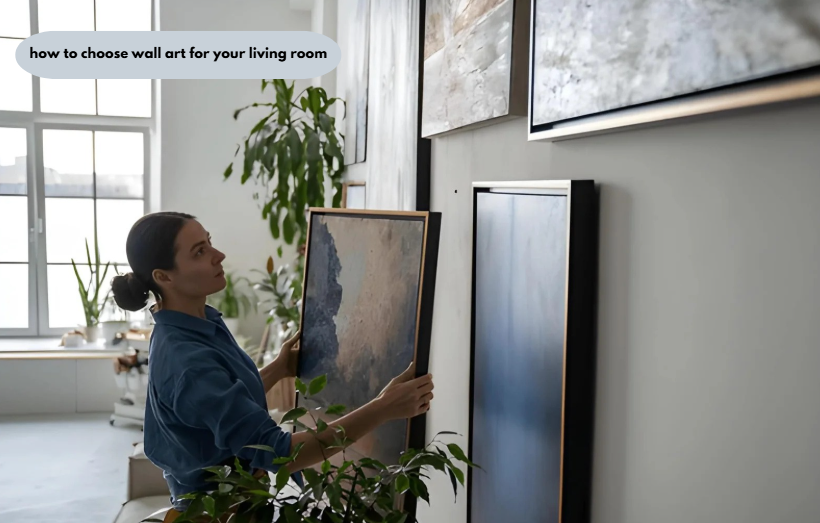
How to Choose Wall Art for Your Living Room: A Simple Decorating Guide
The answer to how to choose wall art for your living room is to size it first: pick a piece or grouping two-thirds to three-quarters as wide as the furniture below it. Hang it 6 to 8 inches above the sofa back and repeat two colors from the room.
Key Takeaways
- Choose art that spans two-thirds to three-quarters of the width of the furniture below it.
- Hang the bottom edge 6 to 8 inches above the sofa back, or center the art about 57 inches from the floor on an open wall.
- Repeat two colors from the room, such as one from the rug or curtains and one from a pillow or vase, rather than matching the sofa.
- For a gallery wall, keep gaps at 2 to 3 inches so the frames read as one piece.
- Test the spot with a taped-up paper outline first, and judge the height while sitting, because art hung too high is the classic mistake.
What size wall art works best in a living room?
The right size is two-thirds to three-quarters of the width of the sofa, console, or mantel below the art. Smaller pieces look like they are floating, and wider ones make the furniture look undersized.
To find the right size range, take the width of the furniture and multiply it by both 0.67 and 0.75. For a group of frames, measure across the outside edges of the whole arrangement, gaps included.
| Furniture below the art | Example width | Target art width | Arrangement that fits |
| Console table | 48 in | 32 to 36 in | One vertical piece or a stacked pair |
| Loveseat | 60 in | 40 to 45 in | One large horizontal piece |
| Apartment sofa | 72 in | 48 to 54 in | Two pieces side by side |
| Standard sofa | 84 in | 56 to 63 in | One oversized piece or a set of three |
| Long sofa or sectional side | 96 in | 64 to 72 in | A set of three or a grid of six |
Three 18-inch-wide frames with two 3-inch gaps measure 60 inches across, which lands inside the 56-to-63-inch range for an 84-inch sofa.
How high should living room art hang?
Hang art so its bottom edge sits 6 to 8 inches above the furniture, or so its center is about 57 inches from the floor on a wall with nothing below it.
A sofa back that stands 34 inches high puts the bottom edge at 40 to 42 inches. A 30-inch-tall canvas then centers at 55 to 57 inches, so both rules agree.
How to choose wall art for your living room in five steps
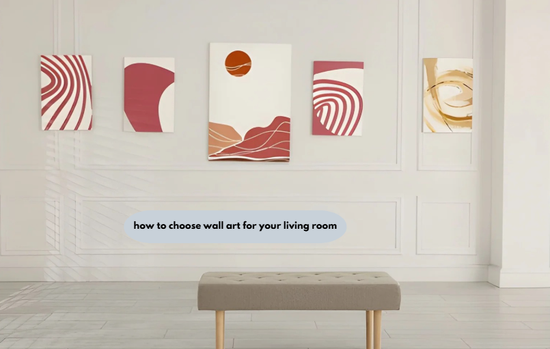
Choose in this order: wall, size, color, subject, frame. Shopping by subject first is the reason so much art ends up the wrong size.
- Pick the wall. The room’s focal wall is usually either the one behind the sofa or the first one you see when you enter.
- Measure and calculate. Write down the furniture width and work out the two-thirds to three-quarters range.
- Pull two colors from the room. Pull one color from your rug or curtains and a second accent color from something smaller like a pillow or vase.
- Choose one mood per wall. Abstracts and landscapes read as calm, while photography and typography read as graphic.
- Match the frame to the room’s finishes. Black, natural oak, or thin brass frames echo lamp bases and cabinet pulls.
Before ordering, cut kraft paper to the exact size and tape it to the wall for two days.
Simple wall decor ideas that look clean and modern share one trait: fewer, larger pieces in repeated frames. Three reliable options:
- One oversized print with a wide white mat
- A pair of identical frames
- A picture ledge holding three layered pieces
How do you create a gallery wall in a small space?
Use a tight grid of identical frames with 2-inch gaps, and keep the full arrangement inside the width range for the furniture below it. A grid reads as one piece, so it calms a small room instead of cluttering it.
According to the U.S. Census Bureau’s 2024 Characteristics of New Housing, the typical new rental apartment completed that year was 1,001 square feet, while the typical new single-family home was 2,146 square feet. Those figures count two different housing types, and the apartment number is about 47 percent of the house number, so plan a rental wall at a loveseat scale.
A worked example for a 51-inch loveseat:
- Target width: 34 to 38 inches
- Frames: six, each 10 by 12 inches on the outside
- Layout: two rows of three with 2-inch gaps
- Result: 34 inches wide and 26 inches tall, which meets the range
The short version of how to create a gallery wall in a small space is to shrink the gaps, not the frames. Lay the frames on the floor and trace each one onto paper before making a hole.
How much should you spend on living room wall art?
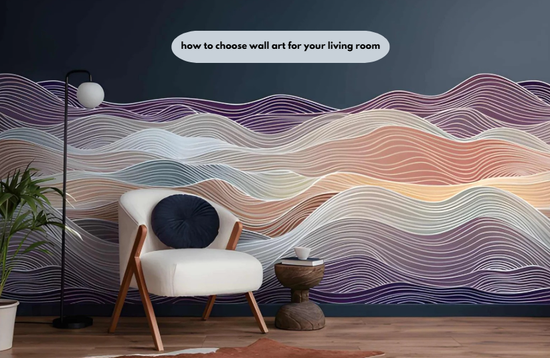
Set the art budget as a fixed share of the room’s total budget, and 10 percent is a workable ceiling for most rooms.
The 2026 U.S. Houzz & Home Study found that the median living room renovation cost $5,000 in 2025, compared with $4,000 the year before. That $1,000 rise is a 25 percent jump, and a 10 percent share of the newer figure gives you $500 for art and framing. That number reflects the full cost of renovations rather than decorating alone, so adjust the guideline to match what you actually plan to spend.
Three ways to stretch the money:
- Ready-made frames in standard sizes, such as 16 by 20, 18 by 24, or 24 by 36 inches, avoid custom framing fees.
- For home upgrading on a budget, start with paint, then furniture, and save art for last, since choosing the right art size depends on the colors and pieces already in place.
- Treat art as a home upgrade that moves with you, unlike paint or flooring.
How do you decorate a blank wall without damaging it?
Fill it with one large piece, a matched pair, or a picture ledge, and hang lighter frames with adhesive strips instead of nails.
Renters asking how to decorate a blank wall usually face two limits: no holes and no heavy pieces. Four pairs of Command Large Picture Hanging Strips hold 16 pounds and a frame up to 24 by 36 inches, according to 3M’s product specifications. Weigh the framed piece on a bathroom scale first, and use a wall anchor or a screw into a stud for anything heavier or larger.
Leave at least 6 inches between a frame and any wall-mounted home device, such as a thermostat or smart speaker. Count a wall-mounted TV as one of the pieces in the arrangement.
What is the most common wall art mistake?
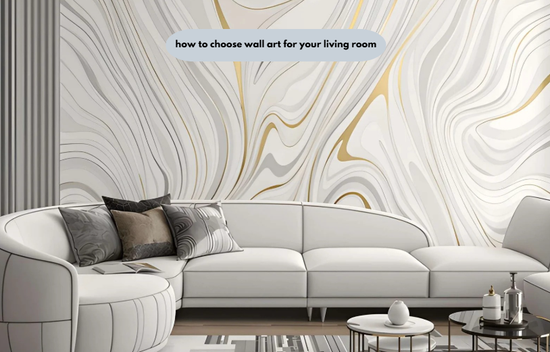
Hanging art too high is the most common mistake, and it happens because people set the height while standing close to the wall.
The usual decoratoradvice to hang art at eye level gets misread as the eye level of the tallest person standing. The fix takes two people: one sits on the sofa while the other holds the paper template and marks where the bottom edge rests 6 to 8 inches above the sofa back.
These rules bend in three situations. With ceilings above 10 feet, raise the center to 60 to 62 inches; above a fireplace mantel, cut the gap to 4 to 6 inches because the mantel already sits high. On a wall that takes direct sun for hours a day, choose canvas or a frame with UV-filtering glazing instead of original works on paper.
Frequently Asked Questions
Should wall art match the sofa?
No, wall art should repeat one or two colors from the room rather than match the sofa exactly. An exact match makes the art disappear, while a shared accent color ties the wall to the pillows, rug, or curtains.
How many pieces of art should a living room have?
For most living rooms, stick to one focal piece or grouping per wall. Leave at least one wall empty so the eye has a place to rest and the focal wall keeps its impact.
Can you mix frame colors on one wall?
Yes, but limit a single wall to two frame finishes. Keep the mat color the same across every frame so the mix looks deliberate.
Is one large piece better than a gallery wall?
One large piece is better for a calm, low-effort look, and a gallery wall is better for displaying several small items. A single piece needs one hook and one measurement, while a six-frame grid needs a paper layout and about an hour.
How far apart should two pictures hang?
Hang paired pictures 2 to 3 inches apart so they read as a single unit. Once the gap passes 5 inches, the eye treats them as two separate pieces, and the wall looks unfinished.
Conclusion
How to choose wall art for your living room comes down to arithmetic before taste: measure the furniture, multiply by two-thirds and three-quarters, and shop inside that range. Hang the bottom edge 6 to 8 inches above the sofa, repeat two colors from the room, and the wall looks finished.