Creative Reading Nook Ideas for Small Spaces: Cozy Designs That Maximize Comfort
The best reading nook ideas for small spaces use an unused corner, window, or closet of about 9 to 16 square feet, fitted with one comfortable seat, a focused light, and wall-mounted book storage. Most setups take a single afternoon and need no construction, which suits renters.
Key Takeaways
- A complete reading nook fits in 6 to 16 square feet of floor space.
- A seat, a task light, and a surface for a drink are the only three required parts.
- Wall-mounted shelves and plug-in sconces keep the floor clear and the nook renter-friendly.
- Warm white bulbs between 2700K and 3000K suit evening reading better than cool white bulbs.
- Measuring the spot before buying the chair prevents the most common nook mistake.
What Is a Reading Nook?
A reading nook is a small, dedicated spot in a home setup with a seat, a light, and nearby books so reading has its own place.
How Much Space Does a Reading Nook Need?
A reading nook needs between 6 and 16 square feet, depending on the seat. A floor cushion or window bench sits at the low end, and a full armchair with a side table sits at the high end.
The median apartment built for rent in 2024 measured 1,001 square feet, while the median new single-family house measured 2,146 square feet, according to the U.S. Census Bureau’s 2024 Characteristics of New Housing. A 16-square-foot armchair nook therefore claims 1.6% of that apartment and 0.7% of that house.
The table below applies the same math to five layouts, using typical footprints for each seat type.
| Nook type | Typical footprint | Floor area | Share of a 1,001 sq ft apartment | Best for |
| Armchair corner | 4 ft x 4 ft | 16 sq ft | 1.6% | Long reading sessions |
| Closet nook | 5 ft x 2 ft | 10 sq ft | 1.0% | Privacy and quiet |
| Floor cushion corner | 3 ft x 3 ft | 9 sq ft | 0.9% | Kids and renters |
| Bed-end bench | 5 ft x 1.5 ft | 7.5 sq ft | 0.7% | Bedrooms with no spare corner |
| Window bench | 4 ft x 1.5 ft | 6 sq ft | 0.6% | Daytime readers |
The most common sizing mistake
Buying the chair first is the mistake that ruins most small nooks. Showroom floors make furniture look smaller than it is, so a 38-inch-wide armchair ends up wedged into a 36-inch gap.
The fix takes five minutes. Mark the chair’s width and depth on the floor with painter’s tape, add 12 inches in front for legroom, and walk past it for a day before ordering.
What Are the Best Reading Nook Ideas for Small Spaces?

The best reading nook ideas for small homes reuse space that already sits empty: corners, windows, closets, and the foot of the bed. Each one below works without moving a wall.
1. The empty corner
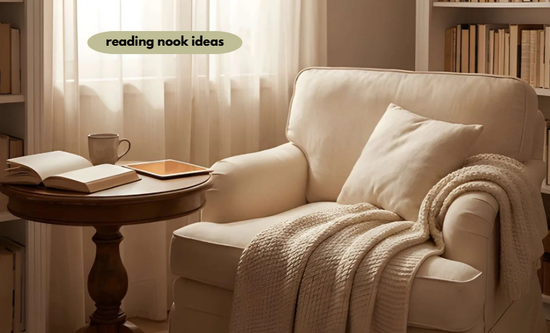
A corner needs only a chair angled at 45 degrees, a wall sconce, and a small table. Angling the chair makes the corner feel intentional and leaves a triangle of space behind it for a basket of books.
2. The window bench
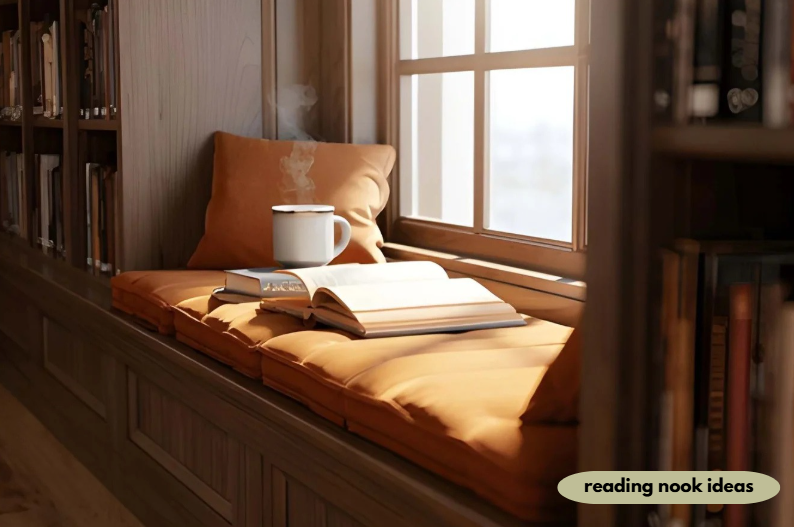
A window bench gives free daylight and the smallest footprint of any seated nook. A storage bench 16 to 18 inches high with a 3-inch cushion matches standard chair height and hides blankets inside.
3. The converted closet
A reach-in closet becomes a private nook once the doors come off. Remove the hanging rod, add a cushioned bench across the width, and mount a sconce on the side wall. Keep the hardware in a labeled bag so the closet goes back together at move-out.
4. The bed-end bench
A bench at the foot of the bed suits bedrooms with no free corner. Add a clip-on or floor lamp and a wall shelf at shoulder height, and the bedroom gains a seat that is not the bed.
How Do You Light a Reading Nook?
Light a reading nook with one adjustable task lamp placed beside and slightly behind the shoulder, aimed at the page. Overhead ceiling lights alone leave the book in the reader’s own shadow.
A bulb of about 800 lumens matches the output of an old 60-watt incandescent, and about 450 lumens matches a 40-watt bulb, according to the U.S. Department of Energy’s Energy Saver guidance. Choose the 800-lumen bulb for the main reading lamp and save the 450-lumen bulb for a soft accent light.
Check the color temperature on the bulb’s label as well. Bulbs rated 2700K to 3000K give a warm glow that suits evenings, while 4000K and higher feel like an office.
Plug-in sconces solve the outlet problem in rentals. They hang on two screws, the cord runs down the wall under a paintable cover, and no electrician is needed.
How Do You Style a Reading Nook Without Clutter?
Style a reading nook with three layers only: books, one textile, and one personal object. Anything beyond that turns a small corner into a storage pile.
Good floating shelf decor follows a two-thirds rule. Fill two-thirds of each shelf with books and leave one-third open for a plant, a framed photo, or nothing at all.
Shelves 8 to 10 inches deep hold most hardcovers without sticking out into the room. Screw brackets into wall studs wherever possible, because a full shelf of books is heavier than it looks.
Two practical decor tips for a clean and calm space apply here. Limit the nook to two main colors plus one accent, and give every loose item a container, such as a basket for throws and a tray for glasses and remotes.
The most repeated decoratoradvice for small rooms is to lift storage off the floor, and a nook proves why. A wall shelf and a sconce free up the square footage that a bookcase and a floor lamp would take.
How Do You Set Up a Reading Nook in One Afternoon?
Set up a nook in one afternoon by measuring first, placing the seat second, and adding light and storage last. This order makes it one of the most reliable quick home decor updates for busy people.
- Pick the spot. Choose the quietest corner with an outlet within 6 feet.
- Tape the footprint. Mark the seat size on the floor and confirm the doors and drawers are still open.
- Place the seat. Angle it toward the room, not the wall.
- Add the light. Place the lamp next to the shoulder you read over, then try it out with a book once it’s dark.
- Mount one shelf. Hang it within arm’s reach of the seat.
- Finish with one throw, one pillow, and a small table or wall ledge for a drink.
Americans age 15 and older averaged 17 minutes a day reading for personal interest in 2024, according to a 2026 Bureau of Labor Statistics analysis of the American Time Use Survey. At that pace, a nook hosts about 103 hours of reading a year, so seat comfort deserves the largest share of the budget.
Two home hacks stretch that budget. A dining chair with a seat cushion and a lumbar pillow stands in for an armchair, and a sturdy wall ledge replaces a side table.
As a home upgrade, a nook is also fully reversible. Every piece moves with the household, and the only repair at move-out is filling a few screw holes.
When a Dedicated Nook Is the Wrong Choice
A fixed nook does not suit every home. In a studio under about 400 square feet, a 16-square-foot armchair corner takes 4% of the floor, and that space is usually needed for dining or work. In that case, build the nook into the bed: add a wedge pillow, a wall-mounted swing-arm lamp, and a shelf above the headboard. The same approach works better for readers with back or mobility limits who read most comfortably lying down.
Frequently Asked Questions
How small can a reading nook be?
A reading nook can be as small as 6 square feet, which is the footprint of a 4-foot window bench. Floor cushion setups need about 9 square feet, and armchair setups need about 16.
What is the best chair for a small reading nook?
The best chair for a small nook is an armless or slim-armed accent chair under 30 inches wide. A high back supports the head during long sessions, and exposed legs make the corner look less crowded.
How do you make a reading nook in a rental?
Make a rental nook with freestanding and plug-in pieces that leave only small screw holes behind. A plug-in sconce, one shelf, and a chair all leave with the tenant.
What color light is best for reading at night?
Warm white light between 2700K and 3000K is best for reading at night. It is bright enough to see print clearly and feels softer than cool white light in the evening.
Can a reading nook go in a bedroom?
Yes, bedrooms are among the simplest places to set up a reading nook. The end of the bed, a spot by the window, or the corner next to the dresser all have space for a chair and a lamp.
How do you make a reading nook feel cozy?
Give your nook a cozy feel by adding soft fabrics, warm lighting, and something that makes the space feel tucked away. A throw blanket, a rug underfoot, and a chair tucked beside a wall or curtain create that enclosed feeling.
Conclusion
The strongest reading nook ideas start with a tape measure, not a shopping cart. Six to 16 square feet, one supportive seat, one 800-lumen lamp, and one shelf turn an ignored corner into the most used spot in the house. Small homes do not need more room for reading, only a place set aside for it.